Tuesday, September 2, 2014

The Croods :)


Eep (Emma Stone) is a girl in a family of cavemen living and hunting in pre-historic times. Her family is one of the few to survive, mainly due to the strict rules of her overprotective father, Grug (Nicolas Cage). In their cave home, Grug tells a story to the family, which includes his wife Ugga (Catherine Keener), his daughter Sandy, his son Thunk (Clark Duke), and his mother-in-law Gran (Cloris Leachman). He uses the story of a character who mirrors Eep's curious nature to warn the family that exploration and 'new things' pose a threat to their survival, and says to never not be afraid. This irritates the bored and adventurous Eep, and after the family falls asleep, she leaves the cave, against her father's advice, when she sees a light moving outside.

Seeking the light's source, she meets Guy (Ryan Reynolds), a clever and inventive caveboy. She at first attacks him but then becomes fascinated with the fire he creates and is eager to learn more. He tells her about his theory that the world is reaching its 'end' and asks her to join him. She refuses and Guy leaves, but not before giving her a noise-making shell to call him if she needs help. Eep is then caught by Grug (who had been searching for her), and is later grounded for what she had done. Grug brings Eep home and is joined by the rest of the family. Eep tells them about Guy and shows them the shell given to her, only for them to destroy it in fear of 'new things'. An earthquake then occurs, sending everyone running for the cave, only to be stopped by Grug moments before the cave is destroyed by falling rocks. They climb over the wreckage to discover a land with lush vegetation, much different from their usual surroundings of rocky terrain. Grug takes his family into the forest to find a new cave.

The family is chased by a "Macawnivore" (a large, macaw-colored machairodont later called "Chunky") and attacked by a swarm of "Piranhakeets" (deadly red-feathered, piranha-like birds). In panic, Eep finds and sounds a horn similar to that which Guy gave her. Guy hears this and rushes to her. Thinking quickly, he creates a torch of fire, which scares the birds away. The other Croods are captivated by the fire, having never seen it before. They steal Guy's torch and accidentally set the land around them in flames. Some giant corn is also lit, which rockets up to the sky, prompting a display of "fireworks" as the kernels explode. After feeling impressed by Guy's intelligence and 'ideas', Grug bottles him in a hollow log to carry him in, then suggests that they take solitude in the cave of a nearby mountain mentioned by Guy. Guy is forcibly persuaded to lead the way and learns of the Croods' way of living, which he thinks of as unusual.

After an unsuccessful hunting attempt, Guy, his "pet" sloth Belt (Chris Sanders), and Eep build a puppet to fool and lure nearby Turkey-Fish. After they make their capture, the family greedily devours everything they caught. Grug then tells another of his morale-lowering tales, this time mirroring the events of their day. Guy then tells a story of his own about a paradise he calls "Tomorrow".

The next day, the family reaches a path coated in spiked rock which Grug, Thunk, and Gran get pricked upon trying to cross them. A freed Guy tries to flee but then presents one of his inventions called shoes making some out of all the resources he can find for each family member. This gains him some respect from the others except for Grug, who feels jealous of Guy's cleverness. After Guy's ideas help the Croods on their journey, the family members gain something. Ugga, Gran, and Sandy have their first idea to get past carnivorous plants by hiding under flower heads as they pass, Thunk encounters and befriends a crocodile-like dog he calls Douglas, and Eep and Guy grow closer while Grug is stranded in a ravine forcing Ugga to go back for him. The next day, Grug shows the others some of his ideas (like a see-saw, shades made out of wood, and a snapshot that involves the family being slammed with a flat rock) which fail and humiliate him. They soon reach the mountain where Grug is unable to convince the family that settling in a nearby cave is a better option. Angry, he attacks Guy. The two become stuck in tar and Guy reveals his family died drowning in a tar pool and their last words inspired his traditions of "Tomorrow." Grug has a change of heart; he and Guy trick Chunky into freeing them by pretending to be a female "Macawnivore" in trouble.

As they are about to reach their destination, an earthquake opens a deep ravine in their path. Grug throws each of them across the gap and reconciles with Eep while creating the first hug with her. Grug then throws her across the ravine and is left behind. He takes shelter in a cave and makes a torch. After seeing a blank rock face, he paints a large cave-drawing of the Croods and Guy together. He then encounters Chunky, who attacks him until Grug's torch is accidentally blown out, panicking them both. The frightened Chunky lies near Grug for comfort, who then has his first good idea. Using a bigger torch and a large skeletal rib cage, Grug manages to lure the Piranhakeets into transporting himself, Chunky, Douglas, and several other animals across the ravine, barely escaping the oncoming destruction. Afterwards, Grug shares the "hug" when he embraces his daughter again, followed by the Croods inventing the group hug.

The family discovers that they have found an ocean-like area where the sun goes down over the sea. Grug and his family - including Guy, Chunky, Belt, Douglas and all their various pets - settle down in this paradise-like environment. He stops being so over-protective; as a result the family becomes more adventurous, bringing happiness to them all.

Wednesday, August 27, 2014

The 'Selfie': Mental Disorder Or Insight To Getting Better Results?


The news was unbelievable. It spread like wildfire through social media, instantly becoming a FacebookLinkedIn and Twitter phenomenon. It exemplified what news organizations, advertisers, and companies had chased for so long—“going viral.” What was it? It was an announcement that the American Psychiatric Association (APA) had officially classified taking ‘Selfies’ as a mental disorder. In fact, the announcement also stated that the APA also claimed to name the disorder ‘Selfitis.’
Unbelievable news? Yes, because it was apparently a hoax from Adobo Chronicles, a website who uses the tagline ‘up-to-date, unbelievable news.’ No mention of this supposed new ‘Sefitis’ disorder can be found on the APA website, and has not been confirmed by any credible source.
Of course, the story, and the validity of the hoax are undeniably amusing. But, what we found more interesting was the fact that the spoof (published on March 31st) became a viral phenomenon almost overnight. Why did so many people latch on to the notion, and share the presumed ‘news’ story without ever questioning whether or not it was valid? Basically, people loved hating ‘Selfies.’ Why?
Oxford officially named ‘Selfie’ the word of the year in 2013. And, although the word ‘Selfie’ might be popular to say, the concept of taking photos of ourselves seems to come with a perception of either narcissism, or, if nothing else, a sense of humor (one that mocks narcissism).
We actually found the viral nature of the hoax (and concept of the ‘Selfie’) so interesting that we scoured the internet to find data from a reputable organization about how many people are actually turned off by the notion of ‘Selfies.’ Of course, we couldn’t find any credible numbers. We simply found a lot of opinions. Nevertheless, we did find one statistic interesting. The PEW Research Center reported that 91% of teenagers have taken a ‘Selfie’, which might suggest a divided perspective between generations. However, we also know plenty of adults who regularly participate in the cultural trend as well.
Still, why did people love the hoax so much, and what can we learn from it?
The cultural phenomenon of the ‘Selfie’ exposes a very basic human desire—to feel noticed, appreciated and recognized. And, although the ‘Selfie’ may not always elicit the most appropriate type of recognition (possibly why people love to hate it), receiving just a few likes from our Facebook or Instagram friends uncovers a foundational aspect of human psychology that can actually help drive results in the workplace—when people are recognized and feel appreciated, they repeat the behavior that was recognized.
A 10-year, 100,000 person study conducted by The O.C. Tanner Institute andHealthStream HSTM +0.62% throughout the United States and Canada confirms that recognition tops the list of things employees say they want most from their employers. According to the study, 79% of employees who quit their jobs cite a lack of appreciation as a key reason for leaving. And, of the people who report the highest morale at work, 94.4% agree that their managers are effective at recognizing them. In contrast, only 2.4% of people who have low morale say they have a boss who is great at recognition.
Does the desire to be recognized and appreciated feel like a ‘mental disorder’ now?
A survey of mental health professionals conducted by YourTango.com, revealed that the desire to feel appreciated isn’t just for the workplace either—it’s actually critical to a healthy relationship. According to a survey that was focused on finding the most common issues within a marriage, 65% of respondents cited “communication problems,” as the most common factor that leads to divorce. The top communication complaints by men in couples considering divorce were: nagging/complaining (70%), followed by their spouse not expressing sufficient appreciation (60%). The number one complaint (83%) from women who responded was “a lack of validation for their feelings and opinions” (sounds a lot like ‘recognizing’ feelings and opinions).
Love ‘Selfies’ or hate them, this viral hoax gives us all insights that we can use. It reveals that A) there is a human desire to be recognized and appreciated, and B) we shouldn’t make those people closest to us ask for it.
At work: Learn to practice recognition. Look for the people who help you achieve your goals, the people who make your life easier, or those simply brighten your day. Make sure you applaud people for a job well done, and say “Thank you” for their efforts. The study by The O.C. Tanner Institute and HealthStream suggests that the most effective recognition can drive performance, if recognition is practiced frequently, is specific to a goal or effort, and is given in a timely fashion.
At home: Learn to practice appreciation. It’s often those closest to us who we assume don’t need to hear how much we appreciate them. Tell your partner, your children and your friends why you appreciate what they do. As evidenced by the YourTango.com survey, “communication problems” doesn’t seem to be a lack of communication, but instead, a lack of positive communication. Try it.
Online: Okay, so you can see by our marginal attempt at a ‘Selfie’ that we’re not experts at the “duck face” (in fact, we had to ask a 12-year old what that facial expression was called). But, we are experts in seeing the value of the trends—and culling for deeper insights. Just for a week, intentionally recognize the people around you and keep track of it. You’ll not only get a picture that reveals how good you are at recognizing others, but you’ll probably be shocked by the positive responses you generate.


nurnajwa

Sunday, August 24, 2014

Can Deodorant Cause Cancer? ~Danalaximii~

Don’t believe rumors that antiperspirants and deodorants cause breast cancer. Most good studies over the years have not found a link.
One concern has been that paraben preservatives in antiperspirants and deodorants could migrate into breast tissue and cause cancer. However, a new English study published in the Journal of Applied Toxicology found that antiperspirant and deodorant users and women who never used these products had similar levels of paraben residues in their breast tissue.
Parabens are added to many cosmetic, pharmaceutical and food products, and have been detected in nearly all human blood and urine samples. It’s thought that parabens may increase cancer risk because of their weak estrogenic activity, but so far there has been no convincing evidence to support this claim.

Strawberry Plants ~Danalaximii~

Welcome to the last source you will ever need for information about strawberry plants!  You have likely eaten your fair share of those delightful red berries, and we hope to encourage you to learn as much as you can about the flavorful fruits and the strawberry plants that produce them.  We exist to spread excitement about strawberries and hope that you will benefit from the information contained here.
Whether you want information on growing strawberries, eating strawberries, scientific information on the actual strawberry plants or strawberry varieties, or even information about where you can purchase strawberry plants or strawberry seeds, you will find help on Strawberry Plants .org.  This entire site is dedicated exclusively to all things related to the strawberry plant.
Be sure to browse the Reference Pages to the left (or just below this paragraph).  They are a wealth of information on topics related to learning about strawberry plants.  Be sure to come back often as we regularly update this site with new information and details about strawberries and strawberry plants!  And, of course, remember that this site is best read with a bowl of fresh strawberries in hand…

Wednesday, August 20, 2014

Drop a coin, grab a snack - Kiosk-in-a-box spreads in Japan


TOKYO (Reuters) - Japan's long-toiling office workers have an incentive to stay chained to their desks: shrimp-flavoured crackers, cafe-au-lait taffies, spicy potato chips and M&M candy.
Confectionery maker Ezaki Glico has taken convenience to a new level for corporate employees too busy to pop out of the office with kiosks-in-a-box filled with munchies.
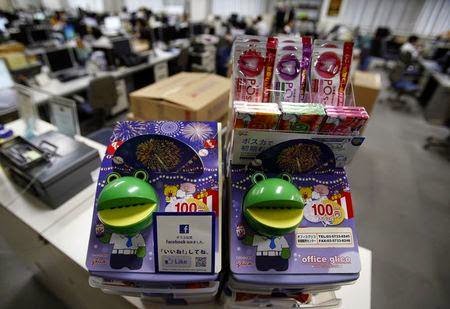
The three-drawer box - roughly the size of a countertop file cabinet - contains 24 items when fully stocked. Company workers simply deposit 100 yen (58p) in a frog-shaped piggy bank, open a drawer and take the snack of their choice.
On the face of it, relying on trust may seem a risk, but Japanese are well known for their honesty. The business is also profitable and at least one major retailer has followed suit.
Goods are replenished or replaced weekly by an army of 500 part-time workers. The contents on offer change every three weeks, adding an element of surprise that vending machines do not provide, said Keisuke Furuyabu, who heads the business, called Office Glico.
"There's an air of mystery and fun," he said.
When a magnitude 9.0 earthquake struck Japan in March 2011 and paralysed the capital's public transportation system, stranded office workers subsisted on Glico snacks.
Notes of gratitude gave the company the idea of marketing Office Glico as a useful addition to disaster relief, said Furuyabu.
"We cleared out the boxes that day, since hundreds of us spent the night at the office," said Nobuhiro Nagasato, an IT worker.
Nagasato routinely nibbles on Office Glico snacks, even though a convenience store is just around the corner. "I can't be bothered to leave the building," he said.
LONG HOURS
Japanese corporate culture is legendary for long working hours. A Japanese worker puts in an average 1,735 hours a year, according to the Organisation for Economic Co-operation and Development (OECD), far more than most European nations.
Office Glico, which also offers a fridge-and-freezer version carrying drinks and ice-cream, now serves 1.8 million people in 100,000 locations, twice the number of Japan's ubiquitous convenience stores.
Last year, it racked up $44 million (£26.5 million) in sales and turned a profit for the first time since it started 12 years ago.
To drive growth, it plans to add breakfast items and midnight meals. It sees potential growth in nursing homes to take advantage of Japan's fast-ageing population, where seniors outnumber children by about two to one. It expects sales to grow another 30 percent in three years.
The company has seen some surprising patterns in demand, Furuyabu said.
Grown men were snapping up baby crackers while bosses were using the snacks as a token treat to thank hard-working staff.
Ezaki Glico, best known for its stick-shaped Pocky snacks, called Mikado in Europe, says inspiration came from unmanned road-side vegetable vendors common in rural Japan.
Convenience chain major FamilyMart started a copycat service, "Office Famima," last year.
Furuyabu says he now gets requests all the time from food makers to be included in Office Glico refreshment boxes. Kameda Seika, a top maker of rice crackers, makes small packages designed exclusively for the box, complete with an Office Glico label.
Could the honour-system work outside Japan, a country where lost wallets regularly end up back with their owners?
"Collection might be an issue," Furuyabu said, acknowledging that Office Glico's 95 percent recovery rate could be tough to replicate beyond Japan's shores.
(Editing by Ayla Yackley and Neil Fullick)
An office worker holds up a snack from Ezaki Glico's kiosks-in-a-box Office Glico, …
nurnajwa

Tuesday, August 19, 2014

Rise of the Guardians :D

Rise of the Guardians poster.jpg


The spirit of winter Jack Frost is lifted with amnesia from the depths of a frozen pond by the Man in the Moon only to discover no one can see, hear, or touch him. Three hundred years later at the North Pole, North, better known as Santa Claus, becomes aware that Pitch Black, the Boogeyman, has returned and is threatening the children of the world. After alerting fellow Guardians the Tooth Fairy (Tooth for short), the Easter Bunny, and the Sandman/Sandy of the problem, North learns that Jack Frost has been selected by the Man in the Moon as the newest Guardian. Jack Frost, frustrated and hurt by centuries of isolation, declines the invitation, but North persuades Jack Frost to cooperate by explaining their mission and the looming threat.
Meanwhile, Pitch Black and his Nightmare minions raid Tooth's palace, taking all the children's teeth and the memories stored within. He also captures Tooth's helper fairies except for a single fairy named Baby Tooth who is rescued by Jack Frost. Resentful that he himself is not believed in, Pitch plans to destroy children's faith in the Guardians and thereby weaken them by preventing Tooth from doing her work. To avert this, the Guardians travel the world collecting teeth, and promise Jack that when they find Pitch, they will help him regain his own baby teeth and through them the memories of his past life. On the expedition, a young boy named Jamie Bennett is delighted to discover the Guardians in his room. He believes in all of them except for Jack, whom he cannot see. Pitch learns of the Guardians' resistance and attacks Jack and Sandy. Despite Jack's efforts to save him, Sandy is overwhelmed and seemingly killed by Pitch.
The dejected Guardians rally by helping Bunnymund prepare his eggs for Easter. Although slightly complicated by the intrusion of Jamie's sister Sophie, the preparation goes smoothly. Jack takes Sophie home, but afterward a mysterious female voice lures him to Pitch's lair where Tooth's fairies and the teeth are being held. Pitch keeps him distracted with the promise of his teeth's memories, while Jack's absence allows the Nightmares to raid Bunnymund's domain, shattering all the eggs, and destroying the children's belief in the Easter Bunny.
After facing the disappointed Guardians, a despondent Jack departs in disgrace to Antarctica. There, Pitch tempts him to join forces, but Jack refuses, claiming that he wants to be loved, not feared. In retaliation for rejecting the offer, Pitch threatens to kill Baby Tooth unless Jack relinquishes the source of his power which is his staff. Pitch breaks the staff and throws Jack and Baby Tooth down into an ice crevasse out of anger, where Baby Tooth convinces Jack to unlock his memories in an attempt to counter his despair. Long ago, his memories teach him, he was a mortal teenage boy who died saving his little sister from falling through the ice of the pond in which he awakened at the film's start. Because of that sacrifice, the Man in the Moon changed him into a spirit and chose him as a Guardian. Inspired by the revelation, Jack restores his staff and returns to help the Guardians.
Due to the power of Pitch's Nightmares, only one child (Jamie) still believes. Jack races to the boy first and strengthens Jamie's wavering faith in the Guardians, but by creating snow in Jamie's room, he causes him to believe that Jack Frost is real. Jamie is finally able to see him much to Jack's delighted surprise. The weakened Guardians arrive to confront Pitch, while Jamie gathers his friends to support them. Pitch's powers prove no match against the children's faith, which allows the restored Guardians to battle Pitch. Sandy is resurrected by this belief and joins the fight, leaving Pitch defeated, the children's faith restored, and Jack with believers of his own. Upon seeing that he is no longer believed because of his defeat, Pitch attempts to escape, but his Nightmares track down his fear and drag him away into his lair.
At this victory, Jack accepts his place as the Guardian of Fun and resolves to protect the world's children with his new friends.

Post for 19th of august :)

Monday, August 18, 2014

EBOLA ~Danalaximii~

Ebola Virus Infection

Ebola is a rare but deadly virus that causes bleeding inside and outside the body.
As the virus spreads through the body, it damages the immune system and organs. Ultimately, it causes levels of blood-clotting cells to drop. This leads to severe, uncontrollable bleeding.

Recommended Related to Food and Recipes

Medically known as food-borne illness or food-borne disease, you probably know food poisoning as miserable -- whatever it's called. It occurs when you eat or drink something contaminated with any number of disease-causing bacteria, viruses, or parasites. And it can result in diarrhea, vomiting, and fever, which can be serious if prolonged, and can lead to dehydration. Most people rarely get sick from contaminated foods because their immune systems are strong enough to protect them. But when harmful...
The disease, also known as Ebola hemorrhagic fever or Ebola virus, kills up to 90% of people who are infected.

Could There Be an Outbreak in the U.S.?

Although movies and books describe major outbreaks of Ebola-like disease in the U.S., they're just fiction. So far serious Ebola cases have only shown up in Central and West Africa.
The CDC says there’s no significant risk of Ebola in the United States.  It has strong safety measures in place for people who have Ebola and are brought to the U.S. for treatment.
Ebola can spread from country to country when people travel. So it is possible for it to reach the U.S. if an infected person travels here. But there are ways to prevent people from coming to U.S. airports with the disease.
Airline crews are trained to spot the symptoms of Ebola in passengers flying from places where the virus is found. Crews are told to quarantine anyone who looks infected.

How Do You Get Ebola?

Ebola isn’t as contagious as more common viruses like colds, influenza, or measles. It spreads to people by contact with the skin or bodily fluids of an infected animal, like a monkey, chimp, or fruit bat. Then it moves from person to person the same way. Those who care for a sick person or bury someone who has died from the disease often get it.
Other ways to get Ebola include touching contaminated needles or surfaces.
You can’t get Ebola from air, water, or food. A person who has Ebola but has no symptoms can’t spread the disease, either.

What Are the Symptoms of Ebola?

Early on, Ebola can feel like the flu or other illnesses. Symptoms show up 2 to 21 days after infection and usually include:
  • High fever
  • Headache
  • Joint and muscle aches
  • Sore throat
  • Weakness
  • Stomach pain
  • Lack of appetite
As the disease gets worse, it causes bleeding inside the body, as well as from the eyes, ears, and nose.  Some people will vomit or cough up blood, have bloody diarrhea, and get a rash.

How Is Ebola Diagnosed?

Sometimes it's hard to tell if a person has Ebola from the symptoms alone. Doctors may test to rule out other diseases like cholera or malaria.
Tests of blood and tissues also can diagnose Ebola.
If you have Ebola, you’ll be isolated from the public immediately to prevent the spread.